
Warm Mist vs Cool Mist Humidifier: Which Is Better for Winter Congestion?
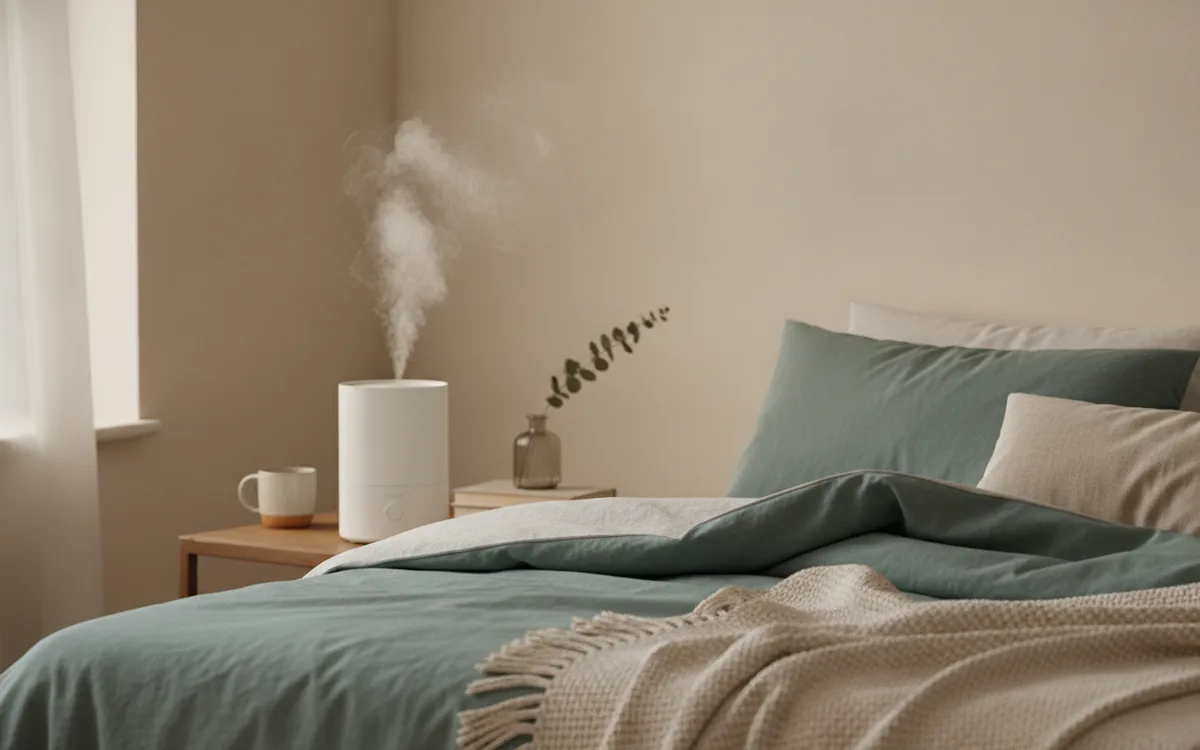
Warm mist and cool mist humidifiers do the same job: they raise the humidity of the room so the air stops drying your nose. Neither type has been shown, in any trial we could find, to relieve a blocked nose better than the other, and neither cures a cold. The differences that matter are safety, cleaning and what the unit puts into the air besides water. For a child's room, cool mist. For a bedroom where cleaning will be patchy, a steam or evaporative unit. For most adults, either, as long as it is cleaned and the room stays under 50% humidity.
A humidifier is worth running in winter only if a hygrometer shows the room is dry. If the room already sits inside the 30% to 50% range the AAFA recommends, dry air is not the cause of your congestion. Adding water then only raises the risk of mould and dust mites.
This guide compares the types and explains what the evidence does and does not say about humidifiers and congestion. It sets out the winter rules, and tells you when a humidifier is the wrong tool.
What each type does
"Warm mist" and "cool mist" describe the output, not the technology. Four designs cover most units on sale.
| Type | How it works | Strengths | Watch out for |
|---|---|---|---|
| Steam vaporiser (warm mist) | Boils water and releases cooled steam | Boiling kills most of what grows in the tank before it reaches the air. The EPA notes steam units are not expected to disperse substantial minerals | Hot water and steam: scald risk for children and pets; uses more electricity; raises room temperature slightly |
| Evaporative (cool mist) | A fan blows air through a wet wick | Output falls as the room gets more humid. The EPA says evaporative units are not expected to disperse substantial amounts of minerals | Wick needs replacing; fan noise; wick can grow mould if left damp |
| Ultrasonic (cool mist) | A vibrating plate turns water into a fine mist | Quiet, cheap to run, no hot parts | Sprays whatever is in the tank into the air. The EPA says ultrasonic and impeller units generally appear to produce the greatest dispersion of minerals and microorganisms. Expect "white dust" with tap water |
| Impeller (cool mist) | A spinning disc flings water through a diffuser | No hot parts, inexpensive | Same dispersion problem as ultrasonic; often noisier |
The US Environmental Protection Agency's humidifier guidance is the source for the mineral and microorganism points above. In plain terms: a unit that boils or evaporates water releases mostly water vapour. A unit that atomises water releases everything in the water, including scale and whatever is growing in the tank.
Does a humidifier help congestion at all?
Honestly, the evidence is thin. Humidifiers do one thing well: they stop dry air drawing moisture out of the nasal lining. In a heated winter bedroom that can fall well below the 30% to 50% range the AAFA recommends for a home, that matters. A moist lining is less irritated, mucus stays thinner, and crusting and nosebleeds are less likely.
What a humidifier does not do is treat the cause of congestion. A cold, an allergy or a structural blockage is unchanged by room humidity. The closest trial evidence is a Cochrane review of heated, humidified air for the common cold. Those trials used a clinical device that blows warm, moist air into the nose at 40 to 47°C, not a room humidifier. Across six trials and 387 participants the authors found the evidence "does not show any benefits or harms" and graded it low quality. No trial has tested a bedroom humidifier against a cold. Treat the humidifier as a comfort measure for dry air, not as a decongestant. Our guide to humidifiers for a stuffy nose covers how to use one well when the nose is blocked.
Warm mist vs cool mist: the decision
Choose cool mist if
- Children or pets can reach the unit. A steam vaporiser holds near-boiling water and a knocked-over unit scalds. Cool mist is the safe default in a child's room.
- The room already runs warm. Warm mist adds a little heat.
- You want low running costs. Evaporative and ultrasonic units use less electricity than boiling water.
Choose warm mist if
- Cleaning will be irregular. Boiling kills most of what grows in the tank before it reaches the air, though the tank and any cup still need cleaning.
- Your tap water is hard and you do not want white dust on surfaces. Steam units leave the minerals behind as scale in the unit.
- You find warm, moist air more comfortable at night. That is preference, not evidence.
If you choose ultrasonic
Use distilled water or water with low mineral content, as the EPA advises, and clean the unit on the schedule below. An ultrasonic unit run on hard tap water and cleaned monthly is the combination most likely to make a winter nose worse. It sprays mineral dust and microbes into the air you breathe all night. The EPA says the health effects of that dust and those microbes are not fully understood, which is reason enough to avoid them. Our humidifier picks for congestion cover units that make cleaning easy.
The winter rules for a humidifier
- Measure before you humidify. Check with a hygrometer on the first cold week. If the room already reads 30% to 50%, you do not need a humidifier for congestion. Our dry-nose guide below explains the full ladder.
- Stay under 50%. The EPA says: "Do not humidify to indoor relative humidity levels exceeding 50 percent." Above that, dust mites and mould thrive and condensation forms on cold windows.
- Empty, wipe dry and refill daily. The EPA's instruction for portable units. Standing water is where bacteria such as Legionella can grow, which is why the daily empty and dry matters more than it sounds.
- Clean every third day. The EPA suggests a 3% hydrogen peroxide solution, then rinsing the tank thoroughly with several changes of water. Follow the maker's instructions where they differ.
- Use distilled water or water with low mineral content in any unit that atomises water, and in any unit if your tap water is hard.
- Keep it away from the bed and the wall. Mist landing on bedding or a cold wall makes a damp patch, and damp patches grow mould.
- Dry it out fully before storing it in spring.
Our guide to dry nose from central heating covers the measure-first decision in more detail and the saline and moisturiser steps that work alongside a humidifier.
When a humidifier is the wrong tool
- The room is already humid. Above 50%, more moisture can make an allergic or asthmatic nose worse. Our guide to winter allergies explains why.
- Congestion is one-sided or constant. That is structural or inflammatory, not dry air. See a doctor.
- Someone in the room has a weakened immune system or lung disease. Ask a doctor first. The EPA notes that the young, the elderly and people with lung disease or respiratory allergies may be particularly susceptible to airborne pollutants from humidifiers. If a doctor agrees, use distilled water and clean on the EPA schedule.
- Someone in the room has asthma. Ultrasonic mist carries whatever is in the tank into the air. Prefer an evaporative or steam unit, use distilled water, and stop if wheeze or cough increases.
- You want it to treat a cold. It will not. Rest, fluids, saline and time do that. Our guide to how long a cold lasts sets expectations.
Children's rooms
Cool mist, placed out of reach, cleaned daily, run only when the room measures dry. Do not put essential oils or menthol products in the water tank of any humidifier. The unit is not designed for them and the mist carries the oil into a small airway. If a steam unit has a separate medicine cup, use only a product labelled for that cup and follow its age limit. Skip it entirely for babies and children under two. The NHS warns against steam bowls around children because of scald risk, and the same logic applies to a steam vaporiser within a toddler's reach. For a congested baby, saline drops and a pharmacist's advice come before any appliance. Our guide to a toddler's stuffy nose at night covers age-safe measures.
When to see a doctor
A humidifier question becomes a medical question when congestion is one-sided or has lasted more than three weeks. Facial pain, bleeding or loss of smell, or a child who mouth-breathes and snores every night, also need a doctor. A new cough, wheeze, fever, breathlessness or flu-like illness that starts or worsens while the humidifier runs needs a doctor. The EPA says stop using the unit and contact a doctor. Do not restart it until a doctor says the symptoms were not linked to it. This pattern can be a lung reaction to microbes in the mist, sometimes called humidifier fever, and it does not clear up by cleaning the tank.
Frequently asked questions
Is a warm mist or cool mist humidifier better for congestion?
Neither has been shown to relieve congestion better than the other. Both raise humidity. Choose cool mist where children can reach the unit, a steam or evaporative unit where cleaning will be patchy, and avoid ultrasonic units with hard tap water.
Should I use a humidifier in winter?
Only when the heating has pushed the room below the 30% to 50% range the AAFA recommends. Check with a hygrometer on the first cold week, not the whole winter. Keep it under 50% and clean it as the EPA advises.
Do humidifiers help with congestion?
They stop dry air irritating the nasal lining, which eases the dry, crusty kind of stuffiness. They do not treat a cold, an allergy or a structural blockage. A Cochrane review of warm, humidified air delivered by a clinical device found no clear benefit or harm for colds, and no trial has tested a bedroom humidifier.
What humidity should a house be in winter?
Between 30% and 50%, and the EPA says not above 50%. Below 30% the nose dries; above 50% dust mites and mould thrive.
Can a humidifier make congestion worse?
Yes. An over-humidified room feeds dust mites and mould, a dirty tank sprays microbes, and an ultrasonic unit on hard water sprays mineral dust. Measure, clean, and use distilled water.
Is a vaporiser (vaporizer) the same as a humidifier?
A steam vaporiser is a warm-mist humidifier: it boils water to make steam. "Humidifier" on its own usually means a cool-mist unit. Both raise room humidity.
This article provides general information. A pharmacist or doctor should guide treatment, particularly for children, in pregnancy, or if you take other medicines.